Showing posts with label Holyoke. Show all posts

13 December 2012

Casino Baby! Fingers Crossed that Holyoke Doesn't Get Forgotten.


This is just a small article about negotiating with "surrounding communities" in terms of road improvements etc. There is no mention of Holyoke as a community near Springfield. I hate to say it, but if Springfield does end up with a casino my guess will be that Holyoke will continue to get screwed.    Our young mayor and all the positive feelings about economic development in certain social circles here doesn't change that as long as Holyoke remains economically insignificant, we will be ignored.

The reason that this upsets and saddens me is that I have been teaching a class at Holyoke Community College this semester (that is just now ending).  We have spent a fair bit of time (even though it is a macro course) discussing the possible economic impacts of a large scale casino/resort coming to the area.  The economic possibilities of a major casino development have my students (rightly so) excited about the future of capital flowing in and job prospects in the area.  A large scale resort is a dream for a young business major /entrepreneur.  Maybe not a great dream, but still the possibility of change is a step in the right direction (in a city that has been taking many small steps in the right direction in recent years).  It is still early in the casino planning phases, but those of us who are working to rejuvenate Holyoke back to the beautiful and economic relevant community it once was need to start fighting this fight now!

Worst case scenario (if the impact on Holyoke of a Springfield casino is totally ignored)....well....
At least with a casino in Springfield we will  have even more more drug money flowing into our city, sigh....
http://www.masslive.com/politics/index.ssf/2012/12/massachusetts_gaming_leaders_u.html#incart_river_politics#incart_m-rpt-2

02 March 2012

What Causes Crime?

Well it's complicated. So let me ask a simpler question.  What causes homicidal feelings?

I can tell you quite simply what causes me to have homicidal feelings*....

A former student (of UMass and two of my courses) who answered the "what causes crime" question in an interview, in reference to the neighborhood we share, along the lines of;  "poor people are greedy and will do anything to have more".  If nothing else, I hope my Marxian economics course gave him the intellectual framework to be the best damn enabler of exploitation he can be! Unfortunately, my guess would be that section of the course was ignored as well.


*Not literally. 

16 February 2012

The Growth of Holyoke Continued:


Probably the last post in this short series.  Unless I decide to share some stuff on the decline: 

YEARS OF BIRTH AND GROWTH

            The first paper mill in Holyoke “Parson’s Paper” was opened in 1853, four years after the completion of the dam.  Many other mills followed, and within 25 years Holyoke had become the largest production center of writing paper in the world. By 1880 Holyoke had more paper mills than any other American local, including production of cheaper quality papers, with 17.
            This period is characterized by massive increases in the organic composition of capital and worker productivity in paper making.  The output of Parson’s Paper increased more than 25 fold from 1854 to 1884 without an increase in the physical size of the mill. By assumption the downward pressure put on the rate of profit by the increasing organic composition was more than offset by productivity gains and relative surplus value. 
The wage of paper workers was fairly stagnant through the second half of the 1800’s.  There were some small increases, especially in the more skilled jobs, but nothing close to the increases in productivity that went along side them.  There was some unionization of paper workers during this time, however workers remained mostly divided along skill divides as well as divides of ethnic origin.  The Holyoke paper worker was usually of Irish Catholic heritage (often first or second generation immigrants).  There was however a large French Canadian immigration wave into Holyoke during this period as well.  It seems a common complaint of the Irish that the French Canadians were willing to work for a wage that was far below V for the Irish workers.  The large population growth in Holyoke during this period seems to have put enough downward pressure on wages that they did not rise even as many more mills opened in the city. 
By 1880 the total population of Holyoke was 22,000 roughly 1900 of these people worked in paper mills.  About 9% of the total population and 25% of the total workforce!  The combined employment of the textile and paper industries totaled more than 50% of the total workforce.  This period, although characterized by increasing capital investment, was still a relatively labor intense one in paper production. There was also a vast difference in the types of labor and wages employed in the mills.   Machine tenders and beaters of the pulp were high skilled jobs and not easily replaceable.  Women in the “rag sorting” room and workers in the finishing departments (often French Canadian immigrants who were willing to work for far less) were easily replaceable.  Class antagonism seems to have been absent for the most part.  Most documentation of workplace disputes points to problems of the Irish owners and skilled workers with the French Canadian (and to some degree Polish) unskilled workers.  Class harmony between labor and capital and a blind eye to exploitation of workers was present from the beginning of Holyoke paper though much of the hundred years the mills were in operation. Even workers in more skilled jobs felt the pressure of a high local immigration rate, as well as ethnic bonds with mill owners.[1]
Profits were not just high because of being able to pay low wages.  During the first 4 decades of paper production in Holyoke the mill owners (in an informal, and sometimes formal, cartel setting) took actions to gain monopoly power.   The mills had a rising organic composition of capital that was lowering average costs for the mills as their production vastly increased.  In a competitive system this would result in a cheapening of the final commodity being produced, in this case cheaper fine writing paper.  The Holyoke mill owners prevented the fall in their profit rate that would come with such a result by colluding to keep prices for writing paper high.   For most of the 1870’s and 80’s most of the mill owners in town meet two or three times a month in a formal organization.  The stated purpose of the organization was to discuss marketing strategies and export markets, however it is well documented that price fixing took place. 


12 February 2012

I really wish I had that data....


To follow up what I just posted on paper production in Holyoke... 

In all my time focusing on Holyoke and its paper mills there is no records (that I have come across) on the prices of paper's major input (prior to the days of wood pulp), cotton rags. 
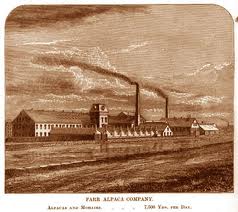
I would think that the scraps left over from textile mills would vary dramatically in price depending upon many factors.  One that really stands out is that within Holyoke a single firm (Farr Alpaca) dominated textile production.  Would they have abused their monopoly power to over charge Holyoke paper mill owners?  Of course, this is capitalism! 

The Growth of Holyoke


As I sit in the wonderful city of Holyoke MA, home, preparing for a guest lecture tomorrow in a legal history course at UMass entitled "What is Capitalism, and How Does it Work?".  I have decided to go the case study route with my lecture.

As such, I have been reading an old, and not particularly excellent essay that I wrote a few years ago on the production of paper in the mills of Holyoke.  We all evolve as scholars, and there is a lot of changes I would make to the paper if I were to write it again today.  I did however want to share the section of the paper that introduces the growth of paper making in Holyoke and the growth of city itself.

Out of context, and without the Marxian analysis that follows in the essay, there is nothing overly exciting here:  I just find some of the growth numbers fascinating, and thought some of you might as well.  I remember reading somewhere that in the early 1900s Holyoke had the highest per-capita millionaires in the United States.  That was largely due to the paper production in "The Paper City" .  70 Years after the decline of paper making (and the wealth of Holyoke) the history of this city has left us with a mediocre brewery of the same name (Paper City Brewery). 

The following is from my paper circa 2008:     
Hope you find the numbers interesting as well, and a public thank you to Dan MacDonald for inviting me to lecture tomorrow.  I am looking forward to it!


Holyoke was transformed during the first half of the 1800’s from an agrarian backwater to a major industrial center.  The two main industries operating in Holyoke were textile production, that was common in much of the region during this time period, and paper making.  There were a number of factors that allowed for a speedy industrialization in Holyoke, although a factor that cannot be understated is its location on a rapidly flowing section of the Connecticut River. 

            During the 1830’s and 40’s two large construction projects were undertaken in Holyoke with the intention of attracting industry.  Holyoke built an intricate canal system allowing for direct fresh water supply to numerous parts of the downtown area,, and built a large hydroelectric dam on the Connecticut River. 

            The canal system was considered vital for paper makers that decided to open shop in the city.  As will be discussed in more detain in the next section 100’s of gallons of water were needed for each pound of fibrous material to turn it into the “chemically pure” pulp needed for high quality paper.  The canals provided easy access to large amounts of water for a much larger number of mills than would have been possible if they were to locate only along the river banks.    

In a stretch leading into Holyoke the Connecticut River falls 70 feet over the span of two miles.  This allows for massive power generation at what is today known as the Holyoke Dam.  The heavy machinery that became part of both the textile and paper making industries required enormous amounts of power by the standards of the middle 19th century.  Proximity to the Holyoke Dam allowed for uninterrupted and relatively cheap access to large quantities of power for manufacturing concerns in the community.  The “Great Dam” as it was then know, was completed in 1849.   

            Another factor that was important for Holyoke paper manufactures was the proximity of a large textile concern (Farr Alpaca) that was also located in Holyoke.  Again to be discussed in the next section one of the inputs for the paper mills of Holyoke was linen and cotton rags.  The proximity of textile manufacturers lowered the cost of these inputs, as they did not have to be shipped far, and could be purchased from local businesses with whom relations were generally good.  In Marxian language it could be argued that it was the possibility of cheaper C compared with other areas that originally encouraged paper mills to open in Holyoke.  It was estimated that in the early days of industrialization a paper mill could be opened in Holyoke for as little as $5000 in initial capital compared with estimates of $8000 to $10 000 elsewhere. 

            The growth of the workforce in Holyoke, and the population in general, tends to coincide with the growth and success of the paper and textile industries in the City.  The first paper mill in Holyoke was opened in 1853 with many more following in the next 10 years.   

Holyoke Population

1850
1855
1860
1865
1870
1875
1880
1885
1890
1896, May      
3,245
4,639
4,997
5,648
10,733
16,260
21,915
27,895
35,674
44,153


            The population numbers of the town and then city of Holyoke (became city sized circa 1870) tell a story of a rapidly growing industrial community during the second half of the 19th century.  Computing an average yearly growth rate for this period yields a whopping 5.85% yearly population growth in Holyoke, compared with the United States national population average growth rate of roughly 2.2% for the same period.  As the textile and paper industries stopped growing so did the population of Holyoke.  As of 2007 the city was home to 39,765 residents.  This is almost 5,000 less people than its peak around 1900.